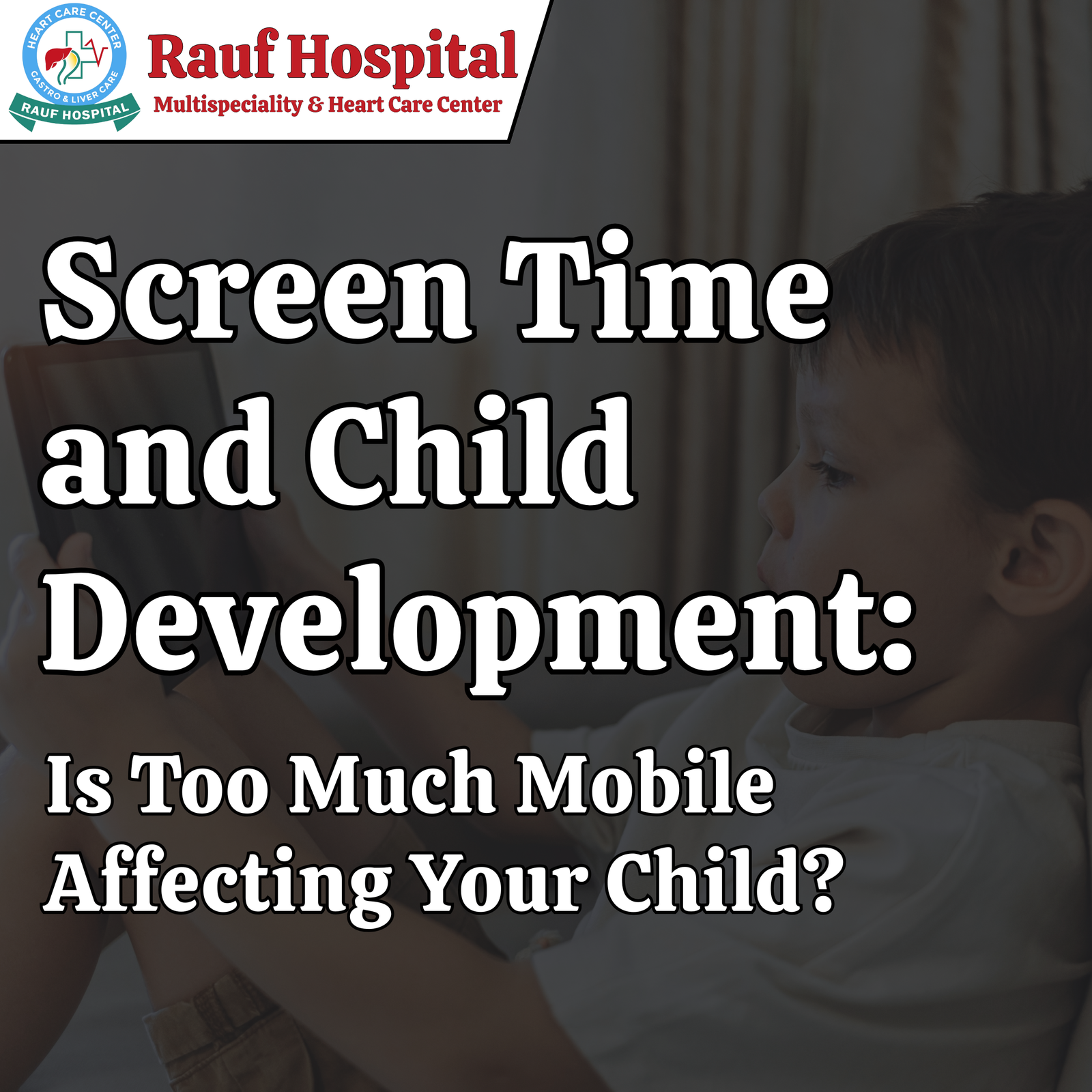
Screen Time and Child Development: Is Too Much Mobile Affecting Your Child?
Understanding How Digital Exposure Impacts Growing Minds
By Dr. Shaista Khan
MBBS, MD (Pediatrics) (KMC Mangalore)
DNB Pediatrics | PGPN
Ex Registrar – Medanta Lucknow
Ex Senior Resident – CNBC, New Delhi
Ex Senior Resident – RML Hospital, Lucknow
Rauf Hospital – Multispeciality & Heart Care Center
Introduction:
One of the fastest-growing concerns among parents today is:
“Doctor, mera baccha mobile bahut use karta hai… kya iska development affect ho raha hai?”
Screens have become a part of modern life.
Children use:
Mobile phones
Tablets
Television
Educational videos
Digital games
But an important question remains:
👉 How much screen time is too much?
While technology itself is not the problem, excessive and unstructured screen exposure during childhood may affect development, behavior, sleep, and daily habits.
Understanding healthy screen habits helps parents create balance—not fear.
What Is Screen Time?
Screen time means the amount of time a child spends using devices such as:
Smartphones
Tablets
TV
Computers
Gaming devices
Not all screen use is the same.
Educational and supervised use is different from prolonged passive viewing.
Can Too Much Mobile Affect Child Development?
Excessive screen exposure may influence multiple areas of development.
This does not mean every child using mobile devices will develop problems.
But balance becomes important.
Areas That May Be Affected
1️⃣ Speech and Language Development
Young children learn language through:
Human interaction
Eye contact
Conversation
Excessive passive screen exposure may reduce opportunities for communication.
Parents often ask:
“Child sab samajhta hai, but bolta kam hai.”
This is one reason pediatric evaluation may become useful.
2️⃣ Sleep Quality
Screen use—especially before bedtime—may affect:
Sleep timing
Sleep duration
Sleep quality
Poor sleep may influence mood and daily energy.
3️⃣ Attention and Concentration
Fast-changing digital content may make it harder for some children to:
Stay focused
Maintain attention
Engage in slower activities
4️⃣ Physical Activity
When screen time increases:
Outdoor play may reduce
Movement decreases
Daily routines become less active
5️⃣ Social and Emotional Development
Children build emotional and social skills through:
Family interaction
Play
Real-life communication
Healthy balance supports overall development.
Warning Signs Parents Should Observe
Consider discussing with a pediatrician if your child:
🚨 Becomes unusually irritable without mobile
🚨 Shows reduced interest in play
🚨 Sleeps late regularly
🚨 Has reduced communication
🚨 Avoids interaction
🚨 Has difficulty focusing
These signs do not automatically mean screen damage—but they deserve attention.
How Much Screen Time Is Better?
Rather than focusing only on exact numbers, focus on quality and routine.
Healthy habits include:
✔ Screen-free family time
✔ Outdoor activities
✔ Reading and storytelling
✔ Supervised content
✔ No screens during meals
✔ Avoid screens close to bedtime
The goal is balance—not complete elimination.
Common Parent Mistakes
❌ Using mobile as the only calming tool
❌ Keeping screens on continuously in the background
❌ Replacing play with digital entertainment
❌ Assuming educational videos are always harmless
What Parents Can Do Instead
Simple changes may help:
Talk more with your child
Encourage creative play
Build routines
Spend device-free family time
Be a role model for screen habits
Children learn more from observation than instruction.
Expert Insight – Dr. Shaista Khan
“Technology is part of modern childhood, but healthy development still depends on interaction, play, sleep, and communication. Balance is more important than complete restriction.”
Pediatric Care at Rauf Hospital
At Rauf Hospital – Multispeciality & Heart Care Center, pediatric care focuses on:
✔ Child growth and development
✔ Behavioral concerns
✔ Nutrition guidance
✔ Child wellness support
✔ Parent counseling
Book a Consultation
Dr. Shaista Khan
Pediatrics & Child Care
🏥 Rauf Hospital – Multispeciality & Heart Care Center
📍 Address:
C/o Dr Wakil Ahmad Ansari
A 32/64, Koyla Bazar, Chittanpura, Varanasi – 221001
📞 Contact:
8884618685
7289020246
Final Thoughts:
Screens are not the enemy—but imbalance can become a concern.
Childhood grows through conversation, movement, curiosity, and connection.
“Children need more eye contact than screen contact.”